Head-to-head comparison
Jackery vs Bluetti: Explorer 1000 v2 vs AC180
Ten dollars apart now: the lighter, faster-charging Jackery or the bigger-battery, higher-output Bluetti. The math, claim by claim.

Published July 21, 2026 · Updated September 18, 2026
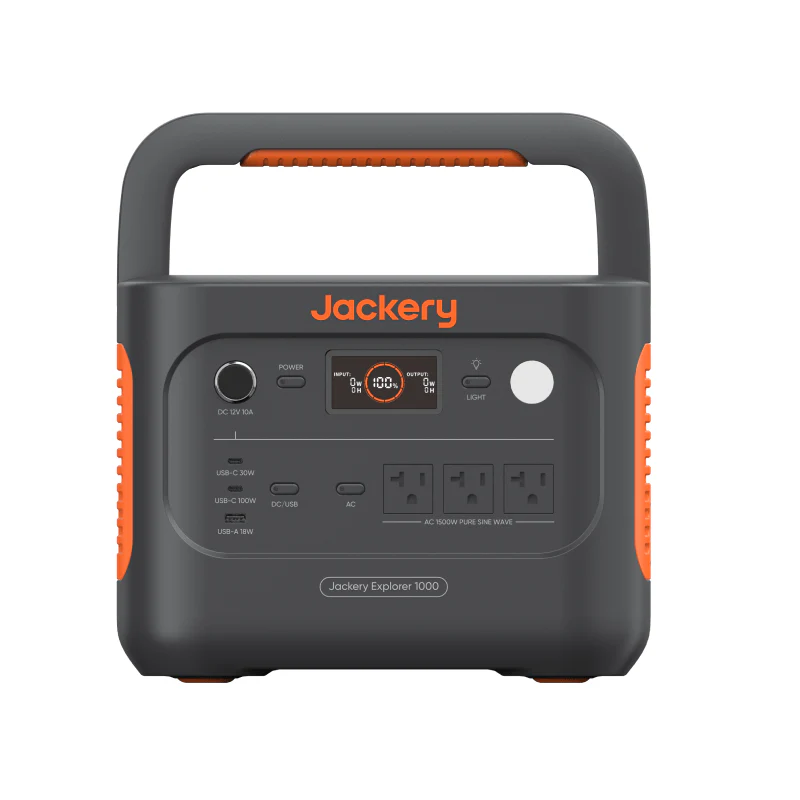
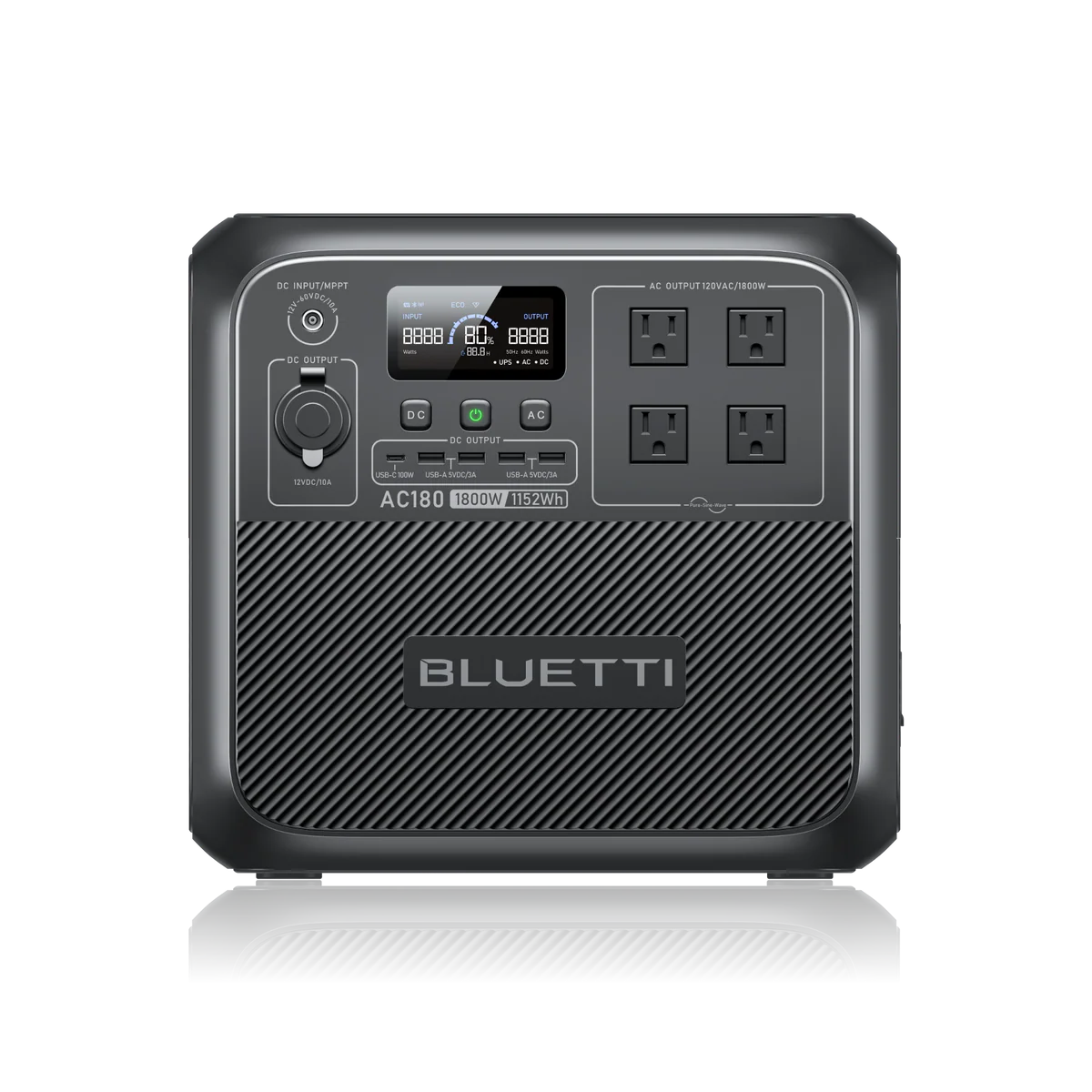
| Jackery Explorer 1000 v2 | Bluetti AC180 | |
|---|---|---|
| Price (2026-09-18) | $489 at Outbound ($559 at Jackery) | $499 (everyday price) |
| Rated capacity | 1,070Wh | 1,152Wh |
| Usable (est. 85%) | ~910Wh | ~980Wh |
| $ per rated Wh | $0.46 | $0.43 |
| AC output | 1,500W (3,000W surge) | 1,800W (2,700W surge) |
| AC outlets | 3 | 4 |
| UPS switchover | 20ms | 20ms |
| Full AC recharge | 1.58 h (1 h emergency mode) | ~1.3–1.8 h (80% in 45 min) |
| Max solar input | 400W | 500W |
| Expandable | No | Yes — to 4,224Wh with B-series packs |
| Weight | 23.8 lb | 35.3 lb |
| Cycle life | 4,000 to 70%+ | 3,500+ to 80% |
| Warranty | 3+2 years (via jackery.com) | 5 years |
Verdict — Bluetti AC180 wins
Ten dollars apart, and the Bluetti AC180 simply ships more of what a blackout consumes: more watt-hours, more output, more outlets, and an expansion path. The July version of this page called it a tie on price; Jackery has since raised its own store to $559, so the AC180 now wins on everyday pricing too. Buy the Jackery if the 11.5-pound weight difference matters more to you than the extra runtime — for a stay-home backup box, it shouldn't.
Two boxes, effectively one price. When we published on July 21, 2026, both rang up at exactly $499 on their manufacturers' stores. That tie has since broken in the Bluetti's favour: Jackery raised the Explorer 1000 v2 to $559 on its own store, and the cheapest source for it is now Outbound Power at $489, against the AC180's unchanged $499. Ten dollars apart is close enough that this remains the purest capacity-math question on the site: at essentially the same price, where do the watt-hours land?
The value math
The AC180 wins the division: 1,152Wh rated for $0.43/Wh against the Jackery's 1,070Wh at $0.46/Wh — about 82 rated watt-hours more battery, call it 70 usable after inverter losses. On our standard fridge-CPAP-router load (~77W average) that's roughly 13 hours of runtime against 12 — one extra hour of fridge, every outage, forever, for ten dollars. Against Jackery's own $559 the Bluetti is both cheaper and bigger, which is the version of this comparison most buyers will meet if they start at jackery.com.
It also wins output: 1,800W continuous versus 1,500W. That's not an abstract number — it's the difference between a microwave plus the fridge compressor spike coexisting, or the breaker-in-a-box tripping.
What the Jackery's 11.5 pounds buy
The Explorer 1000 v2 is the better object: 23.8 lb against 35.3, a claimed one-hour emergency recharge, and a tighter footprint. If your backup battery doubles as a tailgate or camping battery, that portability is a real feature you'll touch every trip. There's also the fine print running the other way: the Jackery's $489 is a retailer's discount against a $799 list and a $559 manufacturer price, while the AC180's $499 is its everyday number — and Bluetti's flat 5-year warranty beats Jackery's 3+2 registration dance.
One more asymmetry that matters for storm country: the AC180 has an expansion path (B-series packs up to 4,224Wh) and a slightly higher solar ceiling. The Jackery is what it is on day one, forever.
Who should buy which
Buy the AC180 if this unit's job is home backup, full stop. More energy, more output, more outlets, longer warranty, room to grow — at the identical price, that's the whole scorecard.
Buy the Explorer 1000 v2 if the box travels — the weight gap is real, the fast emergency recharge is genuinely useful on the road, and the runtime sacrifice is one hour on a twelve-hour job.
Frequently asked
- Is the AC180's price also a sale price?
- No — $499 is its everyday list price on Bluetti's store, and it has not moved since we published. The Jackery's has, twice: its $499 was a sale against a $799 list, Jackery has since raised its own store price to $559, and the $489 in the table above is Outbound Power's number rather than the manufacturer's. That is exactly the scenario this answer warned about, and the Bluetti's math got better, not worse.
- Which one lasts more years?
- The spec-sheet claims differ in shape: Jackery rates 4,000 cycles to 70% remaining capacity, Bluetti rates 3,500+ cycles to 80%. Those are different yardsticks, not a 500-cycle gap — both are LiFePO4 packs that will realistically outlive a decade of outage duty, and Bluetti backs it with the longer flat warranty (5 years vs 3+2).
- Can either run a space heater or window AC?
- The AC180's 1,800W handles a small 550W window AC with room to spare and most 1,500W space heaters at the edge of its rating; the Jackery's 1,500W is the edge. Neither has the capacity to run heat or cooling for long — budget roughly 90 minutes of a 1,500W heater on either.
Sources
- 01checked 2026-09-18
Jackery Explorer 1000 v2: $559 on Jackery's own store, up from $499 on 2026-07-21, and $489 at Outbound Power; 1,070Wh, 1,500W/3,000W surge, 3 AC outlets, 20ms switchover, 400W max solar, 23.8 lb, 4,000 cycles to 70%+, 3+2-year warranty
https://www.jackery.com/products/jackery-explorer-1000-v2 - 02checked 2026-09-18
Jackery Explorer 1000 v2 at Outbound Power: $489, the cheapest source for the unit now that Jackery's own store is $559
https://outboundpower.com/products/jackery-explorer-1000-v2-portable-power-station-1070wh-1500w-400w-solar-input - 03checked 2026-09-18
Bluetti AC180: $499 list, unchanged since 2026-07-21; 1,152Wh, 1,800W output (2,700W surge), 4 AC outlets, 20ms switchover, 500W max solar, expandable to 4,224Wh with B-series batteries, 35.27 lb, 3,500+ cycles to 80%, 5-year warranty
https://www.bluettipower.com/products/ac180