Single-product review · Tested August 27, 2026
Bluetti Elite 200 v2 Review: An Outage Buyer's Read
Tested against our fridge-CPAP-router load: the cheapest lifetime cost per kWh on this site, and a closed system that can never grow past 2,073.6Wh.

Published August 30, 2026 · Updated October 7, 2026
Where to buy the Bluetti Elite 200 v2
$1,199 at the time of this review — every price claim is dated in the source ledger below.
Some links on this page are affiliate links — see full disclosure below.
Code AFF5% — 5% off home backup at Bluetti
What works
- +2,073.6Wh is enough for about 42 hours of fridge-only runtime, most of the CDC's 48-hour full-freezer window
- +6,000 cycles to 80% is the longest rated life in our set — about 12,400kWh of lifetime throughput, or roughly 9.6 cents per kWh cycled at $1,199 against the AC180's 12.4 cents and the Anker C2000 Gen 2's 11.0 cents
- +Independent bench testing delivered 1.91kWh from the 2,073.6Wh pack — about 92% of rated, better than the 85% inverter haircut we budget for by default
- +2,600W continuous with 3,900W Power Lifting takes any single-appliance compressor inrush in the house without a second thought
- +Under-15ms UPS switchover, 1,000W of solar input, and 0-80% in 50 minutes on dual AC-plus-solar charging
- +Five-year warranty, matching the AC180 and beating Jackery's 3+2-year split
Watch out for
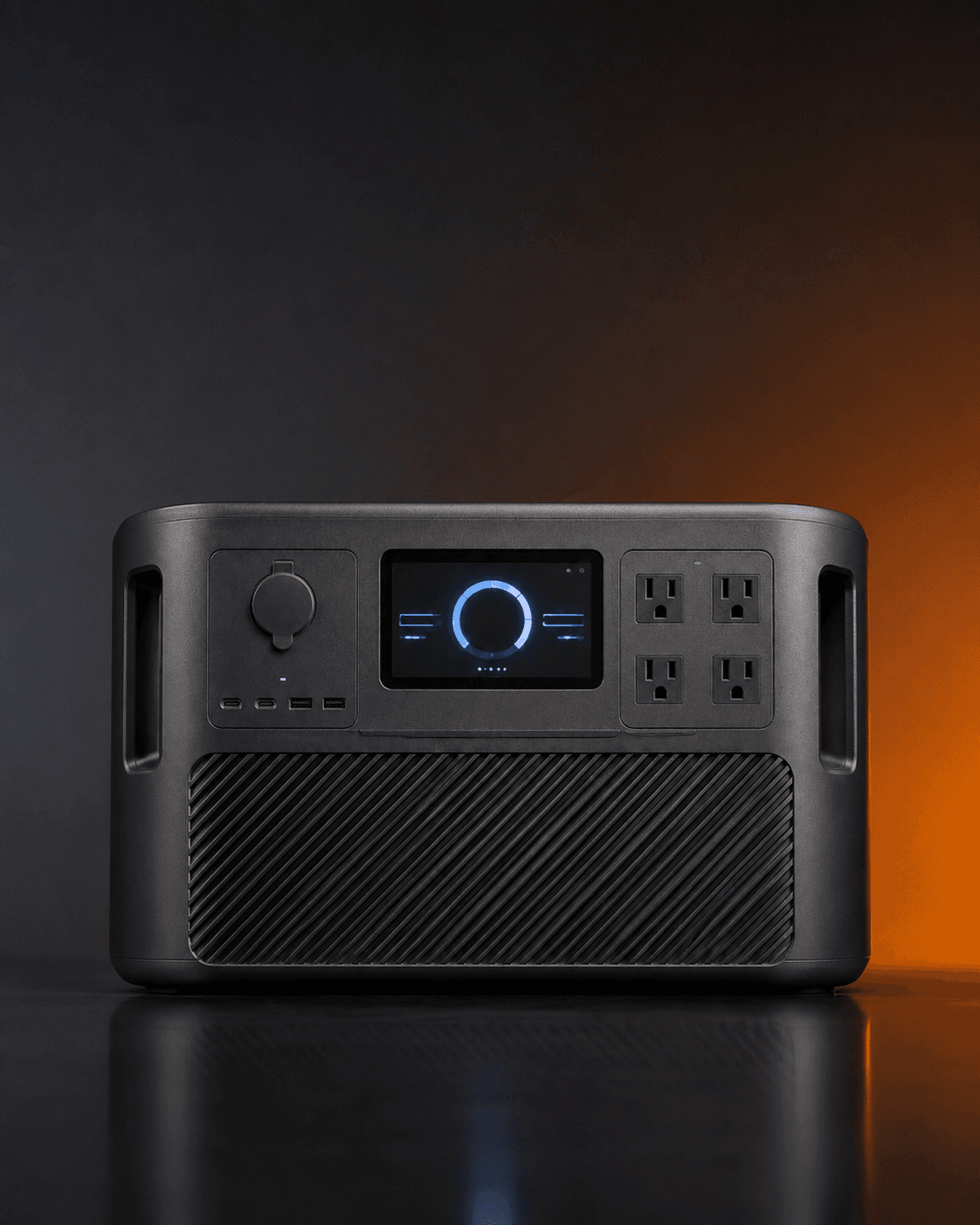
- −No expansion batteries at all — Bluetti's own FAQ calls it a closed system, so unlike the AC180 (4,224Wh) or the cheaper Anker C2000 Gen 2 (4kWh) the capacity you buy is permanent
- −53.4 lb with no wheels and no telescoping handle — 11.7 lb heavier than the Anker C2000 Gen 2, which holds the same capacity in a smaller box
- −One 12V/10A car port is the entire DC output, so anything else runs through the inverter at a conversion loss
- −The inverter auto-sleeps under very small AC loads, which is a nuisance if you're trickle-running string lights or a phone charger overnight
- −$1,199 on Bluetti's store is $0.58 per rated watt-hour, mid-pack rather than best-in-class. The $849 price that made this our value pick was a promotion, and it ended between September 18 and October 7
We ran the Elite 200 v2 through the same test every review on this site uses: charged to full on wall power, then discharged against the fridge-CPAP-router load that is our baseline outage math, with AC output pushed toward its rated ceiling to see where it strains. This is not a lab teardown — that is thesolarlab.com's lane — it is the math and the behavior that matter when the grid drops on an ERCOT summer afternoon.
The value math
At $1,199, Bluetti's price as of October 7, the Elite 200 v2's 2,073.6Wh works out to $0.58 per rated watt-hour. When we reviewed it at $899, and when it dropped to $849 in September, it was the cheapest capacity of anything we'd reviewed, at $0.41. That promotion is over. At full price it's mid-pack, and the Anker C2000 Gen 2 sells the same capacity for $299 less. After our standard 85% inverter-efficiency haircut that is about 1,763 usable watt-hours, which runs the fridge-CPAP-router trio (roughly 77W average) for about 23 hours, or a refrigerator by itself for about 42 hours.
Forty-two hours is the number that matters. The CDC's guidance is that a full freezer holds temperature for about 48 hours unopened, and most outage plans are built to bridge that window. It runs the fridge continuously across most of that window, rather than asking you to keep the door shut and hope. At sale prices it's the cheapest unit we've tested that does that. At $1,199 the Anker C2000 Gen 2 does the same for less.
The number the spec sheet doesn't show you
The more interesting math is what the battery costs over its life, not at checkout. The Elite 200 v2 is rated for 6,000 cycles to 80% — about 12,400kWh of lifetime throughput. Divide the $1,199 by that and you get roughly 9.6 cents per kWh cycled, still the lowest of anything we've reviewed. At September's $849 it was 6.8 cents.
Run the same arithmetic on the AC180, our budget pick: 3,500 cycles against a 1,152Wh pack is about 4,032kWh of throughput, and $499 across it is 12.4 cents per kWh cycled. The Elite 200 v2 is about 22% cheaper per kWh over the life of the pack, despite costing $700 more today. Run it on the Anker C2000 Gen 2, its closest rival, and you get 11.0 cents — 4,000 cycles across a 2,048Wh pack is only 8,192kWh of throughput, barely two-thirds of the Bluetti's. At September's prices that gap was the real difference between them. At $1,199 against $899.99, the Bluetti only comes out ahead once you cycle it past the Anker's rated 4,000 cycles. At a few dozen outages a year, that's longer than either box will be in your house.
One more receipt: independent bench testing pulled 1.91kWh out of the 2,073.6Wh pack, about 92% of rated. That is better than the 85% we budget for by default, and it means the runtime numbers above are conservative — the honest range on a fridge is closer to 42 to 45 hours.
Where it comes up short
It cannot grow. Bluetti's own FAQ calls the Elite 200 v2 a closed system, and there is no expansion port. This is the whole ballgame for a home-backup buyer, and it is worth being blunt about: the AC180 we recommend at $499 scales to 4,224Wh, and the Anker C2000 Gen 2, $299 cheaper than this unit for 25.6Wh less, doubles to 4kWh with a second pack. Whatever you buy here, you own forever. On sale, the unit is excellent value if 2kWh is genuinely enough for your house. If you're guessing, it's a trap at any price.
It is heavy in the least convenient way. 53.4 lb is not unusual for the 2kWh class, but it is 11.7 lb more than the Anker C2000 Gen 2 carries the same capacity in, and the Bluetti has no wheels and no telescoping handle. In practice this is a deliberate two-person carry down a flight of stairs, or a one-person shuffle. Plan on it living where you set it.
The DC side is thin. A single 12V/10A car port is the entire DC output. For a house that is mostly irrelevant, since everything plugs into the wall anyway. If you were eyeing this for a van or a cabin with 12V wiring, you will be running loads through the inverter and paying the conversion loss.
The small stuff: the inverter goes to sleep under very small AC loads, which is mildly maddening if you are running string lights or a single phone charger overnight, and the app is a step behind EcoFlow's.
Who should buy this
Buy it on sale if you have done the load math, 2kWh clears it, and you want the lowest lifetime cost of any battery on this site. At $1,199 we wouldn't. Wait for a promotion under about $900, which this unit has hit three times since August. That is a real and common case — a fridge, a CPAP, phones, and a router through a two-day outage is exactly what this unit is priced and sized for, and the 6,000-cycle pack means it will still be doing it in fifteen years.
Skip it for the Bluetti AC180 if $1,199 is more than you want to commit before you know your real load, or if you want the option to add capacity later. Skip it for the Anker SOLIX C2000 Gen 2, $299 less at the $899.99 we've found it at or under on every check, if the Bluetti isn't on sale, if there's any chance you'll need to scale past 2kWh, or if the unit has to move regularly. Skip it for the EcoFlow Delta Pro 3 if your outage load includes a well pump, a mini-split, or anything else that needs true 120/240V.
Frequently asked
- How long will the Elite 200 v2 run a refrigerator during an outage?
- About 42 hours on the fridge alone. A full-size refrigerator averages roughly 42Wh per hour once you account for the compressor running about a third of the time, and the Elite 200 v2's 2,073.6Wh pack gives about 1,763 usable watt-hours after our standard 85% inverter haircut. That covers most of the CDC's 48-hour full-freezer window with the fridge running the whole time. Add our standard CPAP and router to the load and you're at about 23 hours — a full day and a night, not just an overnight bridge.
- Can I add battery packs to it later?
- No. Bluetti's own FAQ describes the Elite 200 v2 as a closed system, and every independent review we checked confirms it: there is no expansion port and no compatible pack. This is the single most important thing to understand before buying, because it is the opposite of the AC180's pitch — that unit costs $700 less and grows to 4,224Wh. If multi-day grid-down coverage is anywhere in your plan, buy something expandable instead: the Anker C2000 Gen 2 holds the same capacity for $299 less and doubles to 4kWh with a second pack.
- Elite 200 v2 or the Anker SOLIX C2000 Gen 2?
- At October prices, the Anker. We've found it at $899.99 or less on every check, against the Bluetti's $1,199, so you save at least $299 for 25.6Wh less. A BP2000 pack doubles it to 4kWh, it's 11.7 lb lighter in a smaller box, its UPS switches in 10ms against 15, and it has a TT-30 socket for an RV. The Bluetti still wins on pack life: 6,000 cycles to 80% against Anker's 4,000, or 9.6 cents per kWh cycled against 11.0. That's a small edge to pay $299 for up front. When the two are within about $50 of each other, as they were in September, the old rule applies. Buyers who size right once take the Bluetti, and anyone hedging takes the Anker.
- What happened to the $849 price?
- It was a promotion, and it ended. We found the unit at $899 in August and $849 on September 18. By October 7 Bluetti's store was back to $1,199, which is $0.58 per watt-hour instead of $0.41. Amazon had it at $798.99 the same day during its October sale. This price swings by hundreds of dollars between promotions, unlike the AC180's steady $499. Check both stores before you buy, and treat anything under about $900 as the price this review's value case depends on. Bluetti's own store also has a 5%-off home backup promo code that the Amazon listing doesn't.
Sources
- 01checked 2026-10-07
Bluetti Elite 200 v2 on Bluetti's store: US$1,199.00 against a US$1,999.00 compare-at price, up from $849 on 2026-09-18 and $899 on 2026-08-30
https://www.bluettipower.com/products/bluetti-elite-200-v2-portable-power-station - 02checked 2026-10-07
Bluetti Elite 200 v2 on Amazon (ASIN B0DCJV9LTB): $798.99, shown as 33% off a $1,199.00 list price, in stock
https://www.amazon.com/dp/B0DCJV9LTB - 03checked 2026-09-18
Bluetti Elite 200 v2: 2,073.6Wh LiFePO4, 2,600W continuous AC output with 3,900W Power Lifting, 1,000W max solar input, 1,800W max AC input, 53.4 lb, 5-year warranty, and no expansion battery support
https://www.bluettipower.com/products/bluetti-elite-200-v2-portable-power-station - 04checked 2026-09-18
Anker SOLIX C2000 Gen 2, the closest alternative: $899.99, 2,048Wh, 2,400W continuous with 4,000W peak, 4,000 cycles to 80%, 41.7 lb, expandable to 4kWh with a BP2000 Gen 2 pack
https://www.ankersolix.com/products/c2000-gen2 - 05checked 2026-09-18
Jackery has discontinued the bare Explorer 2000 Plus, the unit this review originally named as the same-priced expandable alternative — its product page now offers only refurbished kits, a panel bundle and the battery pack alone
https://www.jackery.com/products/explorer-2000-plus-portable-power-station - 06checked 2026-08-30
Independent bench testing of the Elite 200 v2 discharged 1.91kWh from the 2,073.6Wh rated pack — about 92% of rated capacity — and confirmed the rated 15ms UPS switchover with no reboots or instability across transfers
https://www.storagereview.com/review/portable-power-meets-lab-grade-reliability-bluetti-elite-200-v2-review - 07checked 2026-08-30
Elite 200 v2 is rated 6,000+ cycles to 80% capacity, weighs 53.4 lb with no wheels or telescoping handle, exposes a single 12V/10A car port as its only DC output, and cannot connect expansion battery packs
https://www.thevanconversion.com/post/bluetti-elite-200-v2-review - 08checked 2026-08-30
CDC: a closed refrigerator keeps food safely cold for about 4 hours during a power outage; a full freezer holds a safe temperature for about 48 hours (24 hours if half full)
https://www.cdc.gov/food-safety/foods/keep-food-safe-after-emergency.html - 09checked 2026-08-30
Full-size refrigerator draws roughly 120W while the compressor runs, with the compressor cycling on for about a third of the time — used as one leg of our standard outage-load math
https://www.energy.gov/energysaver/estimating-appliance-and-home-electronic-energy-use - 10checked 2026-08-30
CPAP machines without a humidifier typically draw 40-60W of continuous power during operation
https://www.sleepapnea.org/treat/cpap-therapy/cpap-machine-power-consumption/
Tested pick
Bluetti Elite 200 v2
$1,1994.5/5 tested