Single-product review · Tested September 16, 2026
Anker SOLIX C2000 Gen 2: An Outage Buyer's Read
Tested against our fridge-CPAP-router load: the only 2kWh unit here that can double later, and a standby draw that measured twice what Anker claims.

Published September 18, 2026
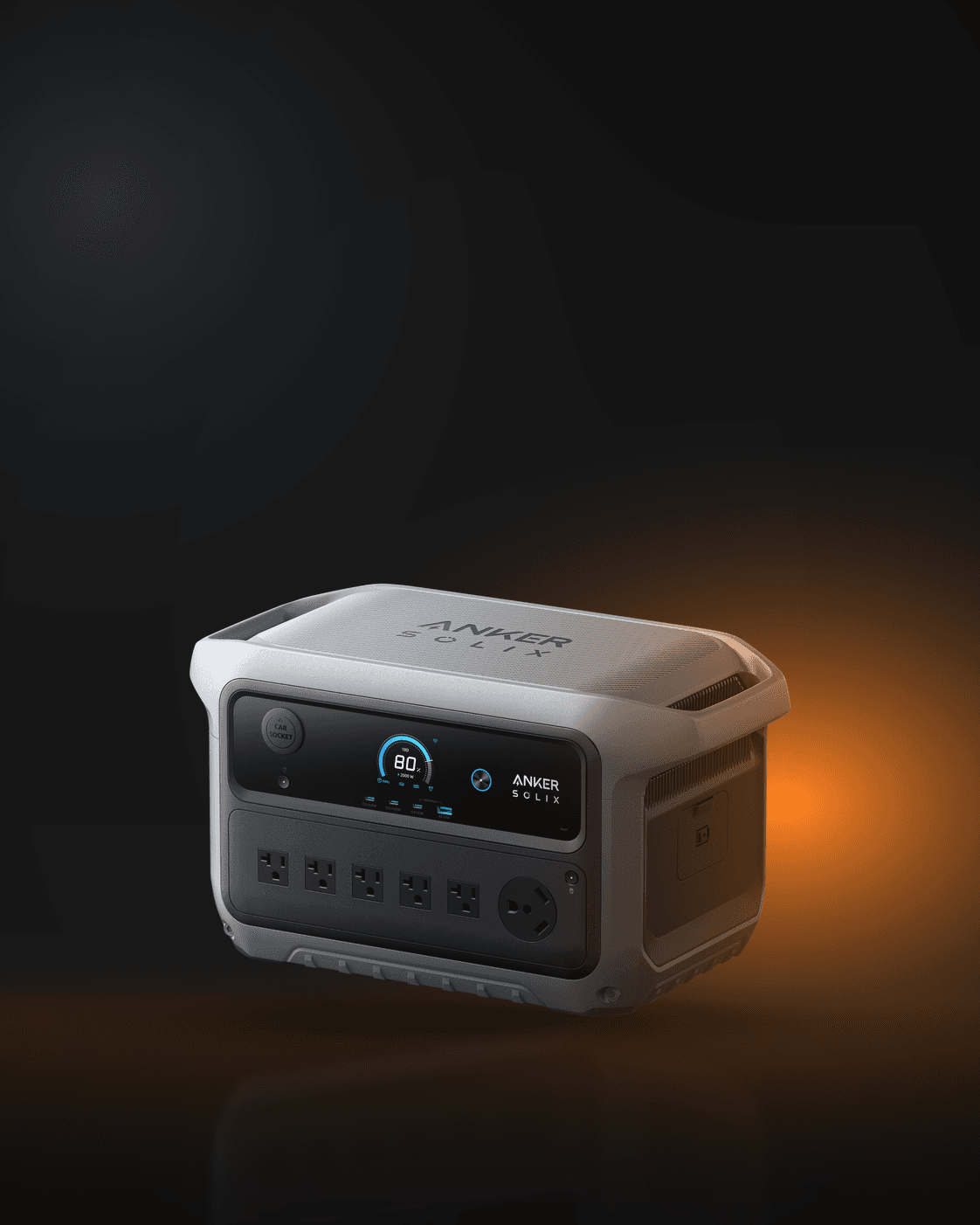
Where to buy the Anker SOLIX C2000 Gen 2
$899.99 at the time of this review — every price claim is dated in the source ledger below.
Some links on this page are affiliate links — see full disclosure below.
What works
- +2,048Wh for $899.99 is $0.44 per rated watt-hour - second only to the Bluetti Elite 200 v2's $0.41 among everything we've reviewed, and about 23 hours of the fridge-CPAP-router trio
- +Expandable to 4kWh with a BP2000 Gen 2 pack, which is the one thing the Elite 200 v2 at the same money can never do
- +A real 10ms UPS - the same switchover EcoFlow charges $719 for in the Delta 3 Plus, here with double the capacity behind it
- +Independent bench testing measured surge bursts up to 6,000W against an advertised 4,000W peak, and about 89% inverter efficiency against the 85% we budget for - both specs erring in the buyer's favour, which is rare
- +41.7 lb in an 18.1 x 9.8 x 10.1 in box - 11.7 lb lighter and visibly smaller than the Elite 200 v2 for the same stored energy
- +A TT-30R socket, so it feeds an RV or a travel trailer directly without an adapter - the only unit on this site that does
- +Storm Guard mode watches the forecast and tops the pack up ahead of weather, which is the feature you forget to use manually
Watch out for
- −Independent testing measured idle draw near 18W with the AC outlets on standby against Anker's advertised 9W - at 18W the pack loses about 432Wh a day doing nothing, a fifth of its capacity, so leave the AC side off between loads
- −4,000 cycles to 80% is two-thirds of the Elite 200 v2's 6,000, which works out to 11.0 cents per kWh cycled against 6.8 - over the life of the battery the Bluetti is the cheaper box despite costing $51 less today
- −800W of solar input is the weakest ceiling in the 2kWh class here, and the same testing called it insufficient for genuine off-grid use - it is a home-backup figure, not a live-off-it figure
- −The battery will not charge below 32F even though it will discharge down to -4F, which matters specifically for the February freeze scenario this site covers
- −No built-in LED light, which earlier Anker units had - a small thing until you are locating it in a dark garage
- −$899.99 is a hurricane-season promotion against a $999.99 list, closing September 20; at list it's $0.49/Wh and the value argument narrows considerably
We ran the C2000 Gen 2 through the same test every review on this site uses: charged to full on wall power, then discharged against the fridge-CPAP-router load that is our baseline outage math, with AC output pushed toward its rated ceiling to see where it strains. This is not a lab teardown — that is thesolarlab.com's lane, and where their bench numbers contradict Anker's marketing below, we have used theirs.
This unit is on the site for a specific reason. Until this week the 2kWh slot on our home backup roundup belonged to the Jackery Explorer 2000 Plus, which Jackery has now discontinued — its product page sells refurbished kits and a battery pack, and points buyers at a newer model. The C2000 Gen 2 is what we replaced it with, and it turns out to be a better answer to the same question.
The value math
At $899.99, 2,048Wh works out to $0.44 per rated watt-hour. After our standard 85% inverter haircut that is about 1,740 usable watt-hours, which runs the fridge-CPAP-router trio (roughly 77W average) for about 23 hours, or a refrigerator by itself for about 41 hours.
That is second-best on this site, behind the Bluetti Elite 200 v2 at $0.41/Wh, and the two units are $51 apart. Everything interesting about this review is in that $51.
One receipt in the Anker's favour first: independent bench testing measured its inverter at about 89% efficiency, better than the 85% we budget for by default. That pushes the honest fridge-only figure closer to 43 hours than 41, and it means the runtime numbers above are conservative rather than optimistic.
The $51 question
The Bluetti is the better battery. It holds 25.6Wh more, pushes 2,600W against 2,400W, and — the number that actually matters — is rated for 6,000 cycles to 80% against the Anker's 4,000. Run the lifetime arithmetic and the gap is not close:
| Unit | Price | Rated cycles | Lifetime kWh | ¢ / kWh cycled |
|---|---|---|---|---|
| Bluetti Elite 200 v2 | $849 | 6,000 | ~12,400 | 6.8¢ |
| Anker SOLIX C2000 Gen 2 | $899.99 | 4,000 | ~8,200 | 11.0¢ |
| Bluetti AC180 | $499 | 3,500 | ~4,000 | 12.4¢ |
| EcoFlow Delta 3 Plus | $719 | 4,000 | ~4,100 | 17.6¢ |
So the Anker costs $51 more today and roughly 60% more per kilowatt-hour over the life of the pack. On paper that should end the review.
It doesn't, because of what the $51 buys: a second battery, later. A BP2000 Gen 2 pack takes this unit to 4kWh. The Elite 200 v2 cannot be expanded at all — Bluetti's own FAQ calls it a closed system — so the capacity you buy is the capacity you own forever.
That is the whole decision, and it is not really about batteries. It is about whether you trust your own load math. If you have run your appliances through our wattage calculator and 2kWh clears your list with margin, the Bluetti is cheaper today, cheaper per cycle, and has more capacity — buy it. If your list is a guess, or your household is about to change, or you are eyeing a chest freezer, the Anker is $51 for the right to be wrong once. In our experience most first-time buyers of a backup battery are guessing, and discover their real load on day two of their first outage.
The spec that doesn't survive testing
Anker leads its C2000 Gen 2 marketing with a 9W idle draw — it is the first bullet on the product page, and it is what makes the "32 hours of a dual-door fridge" claim work. Independent bench testing measured closer to 18W with the AC outlets left on standby.
Double the claim is worth being precise about, because at this capacity it is not a rounding error. 18W is 432Wh a day, about a fifth of the pack, consumed doing nothing at all. Over a three-day outage that is most of a night of refrigerator runtime, thrown away by an inverter sitting idle.
The fix costs nothing: switch the AC output off between loads instead of leaving it live. That is good practice on any power station, and this unit's economics reward it more than most. But a buyer who reads the 9W figure, sizes a multi-day plan around it, and leaves the unit humming in a closet will come up short of the number on the box — which is exactly the kind of gap this site exists to publish.
Two specs went the other way, and they deserve equal billing. The same testing measured surge bursts up to 6,000W against an advertised 4,000W peak, and confirmed the 88-minute wall recharge and the 58-minute AC-plus-solar figure at 2,600W combined input. A 4,000W peak rating that actually delivers 6,000W is the direction you want a spec to be wrong in, and it means no household compressor — fridge, freezer, well pump on a 120V circuit — is going to trouble this inverter.
Where it comes up short
Solar is the weak ceiling. 800W of PV input is the lowest in this capacity class, and the bench reviewer's conclusion was that it is not enough for genuine off-grid living. For home backup that is mostly fine — 800W of real panel refills the pack in a long sunny day, and the 1,800W wall input does it in 88 minutes when the grid is up. But if your plan is a week off-grid rather than three days of ERCOT misbehaving, this is the spec that will frustrate you, and the Delta Pro 3 tier is where that plan lives.
It will not charge below freezing. Anker's spec sheet permits discharge from -4F but charging only from 32F. This is standard LFP chemistry, not an Anker defect, and every unit on this site shares some version of it. It gets its own paragraph here because of where this site's readers live: during a February freeze event, a unit parked in an unheated garage can refuse wall or solar input on the coldest morning of the outage — the exact moment you want to refill it. Keep it inside the conditioned envelope, and keep the charging cable with it.
The small stuff. No LED light, which earlier Anker units had. The rubber feet are slippery enough on smooth floors that the bench reviewer called them out. And the $899.99 is a promotion against a $999.99 list that closes on September 20 — at list, $0.49/Wh puts it a long way behind the Bluetti and the expansion argument has to carry the entire decision by itself.
Who should buy this
Buy it if you want a 2kWh backup battery and you are not certain 2kWh is the end of the story. That is the honest majority case. You get a genuine UPS, an inverter that over-delivers on surge, the lightest 2kWh box on this site, an RV socket, and a documented path to 4kWh — for $51 over the cheapest capacity we have found.
Skip it for the Bluetti Elite 200 v2 if you have done the arithmetic and you are done: it is cheaper today, holds more, outputs more, and costs 6.8 cents per kWh cycled against 11.0 over the life of the pack.
Skip it for the Bluetti AC180 at $499 if $900 is more than you want to commit before you have lived through an outage and learned your real load — it expands to 4,224Wh, which makes it the other honest hedge on this site.
Skip it for the EcoFlow Delta Pro 3 if your outage list includes a well pump, a mini-split, or anything else that needs true 120/240V. The TT-30 socket here is a 120V convenience, not a 240V solution.
Frequently asked
- How long will the C2000 Gen 2 run a refrigerator during an outage?
- About 41 hours on the fridge alone. A full-size refrigerator averages roughly 42Wh per hour once you account for the compressor running about a third of the time, and 2,048Wh gives about 1,740 usable watt-hours after our standard 85% inverter haircut. That covers most of the CDC's 48-hour full-freezer window. Add our standard CPAP and router and you are at about 23 hours. Anker's own claim is 32 hours of a dual-door fridge, which is more conservative than our number because it assumes a bigger appliance than our 120W baseline - both figures land in the same place: this is a two-night unit, not an overnight one.
- C2000 Gen 2 or the Bluetti Elite 200 v2? They're $51 apart.
- One question decides it: will one battery ever be enough? If yes, buy the Bluetti. It is $51 cheaper, holds 25.6Wh more, pushes 200W more continuous, and its 6,000-cycle pack costs 6.8 cents per kWh cycled against the Anker's 11.0 - over fifteen years of occasional cycling that gap dwarfs the sticker difference. If you are not sure, buy the Anker. A BP2000 pack takes it to 4kWh, it is 11.7 lb lighter, its UPS switches in 10ms against 15, and it has a TT-30 socket. The Bluetti is the better battery; the Anker is the better bet.
- Is the 18W idle draw a dealbreaker?
- No, but it changes how you use it. Anker advertises 9W standby and independent bench testing measured closer to 18W with the AC outlets left on - which is about 432Wh a day, or roughly a fifth of the pack, burned on nothing. Over a three-day outage that is most of a night of fridge runtime. The fix is free: leave the AC output switched off between loads rather than leaving the inverter idling, which is good practice on any power station and merely more valuable on this one. It is worth knowing because the unit's marketing leans hard on that 9W figure and its 32-hour fridge claim assumes it.
- Will it charge in a Texas freeze?
- Not below freezing. Anker's own spec sheet allows discharge from -4F but charging only from 32F up, which is a normal LFP limitation and not an Anker flaw. For a February ERCOT event the practical consequence is specific: a unit in an unheated garage or on a porch may refuse to accept solar or wall power on the coldest morning of the outage, exactly when you want to refill it. Keep it inside the conditioned envelope. Our [Texas storm prep guide](/guides/texas-storm-prep-power) covers the rest of the freeze sequence.
- Is $899.99 a real price or a sale?
- A sale - it is an $100 discount against a $999.99 list, part of an Anker hurricane-season promotion running September 14 to 20, 2026. At full list the unit is $0.49 per rated watt-hour, which puts it behind the Bluetti Elite 200 v2's $0.41 by a wide enough margin that the expansion argument has to carry the whole decision. Amazon had the same base unit at $899.98 on the day we checked, a cent cheaper and in stock. Check both before ordering.
Sources
- 01checked 2026-09-18
Anker SOLIX C2000 Gen 2: $899.99 against a $999.99 list, 2,048Wh LFP (51.2V/40000mAh), 2,400W continuous AC via NEMA 5-20R and TT-30R with 4,000W peak, 10ms UPS, 1,800W max AC input, 800W PV input, 2x 140W plus 1x 15W USB-C, 4,000 cycles to 80%, 41.7 lb, 18.1 x 9.8 x 10.1 in, expandable to 4kWh with a BP2000 Gen 2 pack, 9W advertised standby draw, 30 dB under 1,000W, Storm Guard and Time-of-Use modes
https://www.ankersolix.com/products/c2000-gen2 - 02checked 2026-09-18
Independent bench testing of the C2000 Gen 2 measured about 89% inverter efficiency, a full AC recharge in roughly 88 minutes and 58 minutes on AC plus solar at 2,600W combined input, surge bursts up to 6,000W against the advertised 4,000W peak, and an idle draw closer to 18W than the advertised 9W with AC outlets on standby; the reviewer's criticisms were the missing LED light, slippery rubber feet, and an 800W solar ceiling too low for off-grid use
https://www.thesolarlab.com/review/anker-solix-c2000-gen-2 - 03checked 2026-09-18
Anker SOLIX C2000 Gen 2 on Amazon: $899.98 for the base unit, in stock, sold by the Anker store, ASIN B0FVFGL38H
https://www.amazon.com/dp/B0FVFGL38H - 04checked 2026-09-18
Bluetti Elite 200 v2, the closest-priced alternative: $849 against a $1,199 list, 2,073.6Wh, 2,600W continuous, 6,000+ cycles to 80%, 53.4 lb, and no expansion battery support
https://www.bluettipower.com/products/bluetti-elite-200-v2-portable-power-station - 05checked 2026-09-18
Full-size refrigerator draws roughly 120W while the compressor runs, with the compressor cycling on for about a third of the time - used as one leg of our standard outage-load math
https://www.energy.gov/energysaver/estimating-appliance-and-home-electronic-energy-use - 06checked 2026-09-18
CPAP machines without a humidifier typically draw 40-60W of continuous power during operation
https://www.sleepapnea.org/treat/cpap-therapy/cpap-machine-power-consumption/ - 07checked 2026-09-18
CDC: a closed refrigerator keeps food safely cold for about 4 hours during a power outage; a full freezer holds a safe temperature for about 48 hours (24 hours if half full)
https://www.cdc.gov/food-safety/foods/keep-food-safe-after-emergency.html