Single-product review · Tested July 31, 2026
EcoFlow Delta Pro 3 Review: An Outage Buyer's Read
Spec-verified, not lab-tested: what 4,096Wh and a true 240V output buy for whole-house-adjacent backup, and where the $2,799 price stops making sense.

Published July 31, 2026 · Updated August 24, 2026
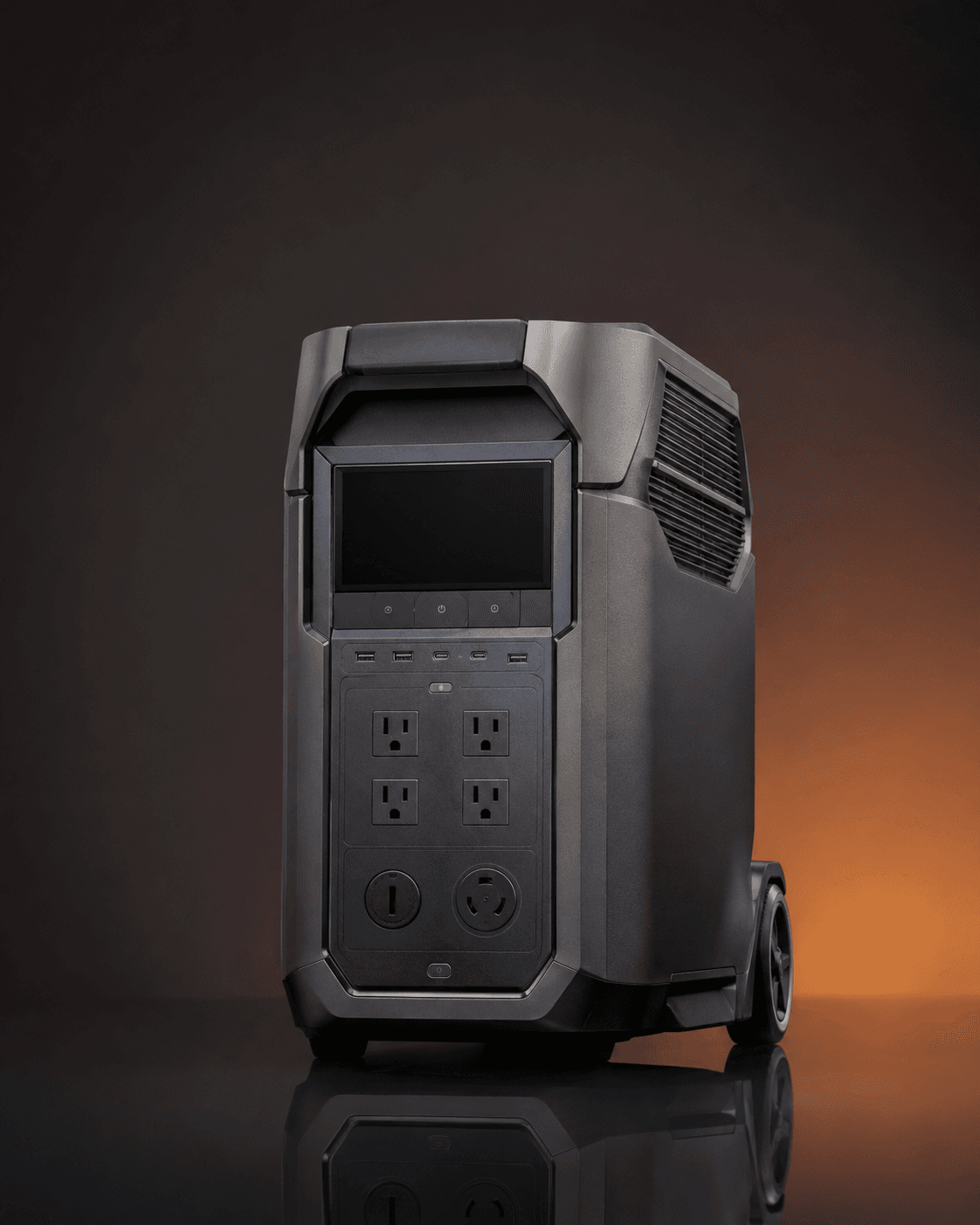
Where to buy the EcoFlow Delta Pro 3
$2,799 at the time of this review — every price claim is dated in the source ledger below.
Some links on this page are affiliate links — see full disclosure below.
What works
- +4,000W continuous output at 120V/240V — reaches a window AC, well pump, or sump pump that 1kWh-class units can't run
- +Sub-10ms EPS switchover — the same instant grid-drop handoff as the site's entry-tier picks, at roughly 4x the capacity
- +2,600W max solar input — a full recharge from panels takes a few hours of sun, not most of a day
- +50-minute 80% wall recharge at 1C charging — a fast top-off in the hours before a forecast storm
- +5-year warranty (3-year standard plus 2-year extension) and a 4,000-cycle rated life to 80%+ capacity
Watch out for
- −113.5 lb — a two-person lift or a wheeled-cart move, not a one-hand carry to a closet
- −$2,799 sale price ($3,699 list) is nearly 6x the entry-tier Jackery Explorer 1000 v2 — real money if your outage load is just a fridge, CPAP, and router
- −The 240V L14-30 output needs a transfer switch — and usually an electrician — to actually reach whole-house circuits; out of the box, it's still extension-cord backup
- −Scaling past the base 4,096Wh requires EcoFlow's add-on battery packs — nothing ships in the box beyond the unit itself
This site doesn't run a testing lab, and this review doesn't pretend otherwise: every number below is verified against EcoFlow's own spec pages and a live retail listing, then run through the same load math as every other review here — an 85% inverter-efficiency haircut, real appliance duty cycles, nothing that assumes a lab-perfect inverter. What follows is what that math says the Delta Pro 3 is actually for.
The value math
At its current $2,799 sale price (list $3,699), the Delta Pro 3's 4,096Wh rated capacity works out to $0.68 per rated watt-hour — after the standard 85% haircut, that's roughly 3,480 usable Wh. Run the fridge-CPAP-router trio this site's other reviews use as a baseline (about 77W average) and that capacity alone covers close to two full days, not the overnight bridge a 1kWh-class unit provides.
That's the wrong way to read this unit, though. Nobody spends $2,799 to run a fridge, a CPAP, and a router for 45 hours when a $499 Jackery Explorer 1000 v2 covers 12 of those hours for a sixth of the price. The Delta Pro 3's case is the loads the small units can't touch at all.
What 4,000W and 240V actually reach
The number that matters here isn't the watt-hours, it's the 4,000W continuous output at 120V or 240V. That's enough headroom for a window AC unit, a well pump, or a sump pump running on its own circuit — appliances that sit at or past the 1,500-1,800W ceiling of the site's entry-tier picks. The 240V L14-30 outlet is the other half of the story: paired with a transfer switch, it can feed real household circuits instead of just whatever's within extension-cord reach. That transfer switch is a separate purchase and usually a separate electrician's visit — this unit is the battery half of a whole-house-adjacent setup, not the whole setup.
The sub-10ms EPS switchover carries over from the site's smaller picks: a CPAP or router doesn't reboot when the grid drops, same as the Explorer 1000 v2's 20ms figure, just with more capacity sitting behind it. And the 2,600W max solar input — more than six times the Explorer 1000 v2's 400W ceiling — means a realistic full recharge from panels in a few hours of direct sun instead of most of a day, which matters if a multi-day outage outlasts your wall-power charge.
The weight and price you're trading for that
None of this is free. At 113.5 lb, this is not a unit you move solo up a flight of stairs — plan on a hand truck or a two-person lift, and a permanent spot near an outlet rather than something you shuffle between the garage and a closet. And at $2,799, it's nearly six times the Explorer 1000 v2's sale price for capacity most single-night outages won't use.
The 50-minute 80% recharge (1C charging) and the 5-year warranty (3-year standard plus a 2-year extension) are the two specs that make the price easier to justify if you do have the bigger load: fast enough to top off ahead of a forecast storm, and covered long enough that the cost amortizes over years, not one bad season.
Who should buy this
Buy it if your outage risk profile includes a load the 1kWh-class units can't run — a window AC, a well pump, a sump pump — or you're planning for a multi-day grid-down event rather than an overnight bridge. Pair it with a transfer switch if "whole-house-adjacent" is the actual goal.
Skip it for the Jackery Explorer 1000 v2 if a fridge, CPAP, and router covering one bad night is the real job — you'll get there for a fifth of the price. Skip it for the Bluetti AC180 on the ranked picks page if you want more watt-hours than the Explorer 1000 v2 without stepping up to Delta Pro 3 money.
Frequently asked
- Is the Delta Pro 3 actually 'whole-house' backup?
- Whole-house-adjacent, not whole-house. The 240V L14-30 output has the headroom to feed a transfer switch and back up real circuits — a well pump, a furnace blower, a handful of rooms — but you need that transfer switch (and usually an electrician) installed first. Straight out of the box, with nothing else added, it's the same extension-cord backup as any other station here, just with far more capacity behind the cords.
- Will it run a window AC unit?
- The 4,000W continuous ceiling has room for one — most window units draw well under that on their own — but run your specific unit's nameplate wattage through our calculator before you buy. A single dedicated load like a window AC is a very different math problem than the fridge-CPAP-router trio this site sizes its entry-tier picks around.
- Why is EcoFlow's own site the primary link here instead of a retailer?
- It is now the only store carrying the base unit that we link to. When this review published, EcoFlow direct was $2,399 against $2,799 at Outbound Power, and we linked EcoFlow on price. Rechecked on August 24, 2026, EcoFlow's own price had risen to $2,799 and Outbound had dropped the base 4,096Wh unit entirely, so Amazon replaced it as our secondary link. The price advantage that originally justified the primary link is gone — the link order now just reflects who stocks it.
- How does this compare to the Jackery Explorer 1000 v2 on this site's picks?
- Four times the capacity and true 240V output, for nearly six times the price. The Explorer 1000 v2 is sized for a one-night fridge-CPAP-router bridge; the Delta Pro 3 is sized for loads that unit can't run at all, or an outage that runs past a single night. If you are not sure which job you actually have, our ranked home-backup picks page sorts both by that exact question.
Sources
- 01checked 2026-08-24
EcoFlow DELTA Pro 3: 4,096Wh LFP battery, 4,000W continuous AC output at 120V/240V, up to 6,000W surge via X-Boost, 4,000-cycle rated life to 80%+ capacity, 5-year warranty (3-year standard plus 2-year extension), $2,799 sale price against a $3,699 list ($900 off)
https://us.ecoflow.com/products/delta-pro-3-portable-power-station - 02checked 2026-07-31
EcoFlow DELTA Pro 3 FAQ: four 120V/20A outlets plus one 120V/30A RV outlet in 120V mode; one L14-30 240V split-phase outlet plus one 6-20R 240V outlet in 240V mode; 2,600W max combined solar input across two PV ports
https://www.ecoflow.com/us/blog/ecoflow-delta-pro-3-faq - 03checked 2026-07-31
EcoFlow DELTA Pro 3 listing (Outbound Power): 113.5 lb unit weight, sub-10ms UPS/EPS switchover, charges to 80% in 50 minutes at 1C charging
https://web.archive.org/web/2026/https://outboundpower.com/products/ecoflow-delta-pro-3-portable-power-station-4096wh-4000w-2600w-solar-input