Guide · Winter outage
Can a Power Station Run Your Gas Furnace in an Outage?
What a gas furnace really draws, how many hours of heat each battery size buys, and the grounding quirk that can keep a furnace from lighting on battery.

Published September 30, 2026 · Updated October 7, 2026
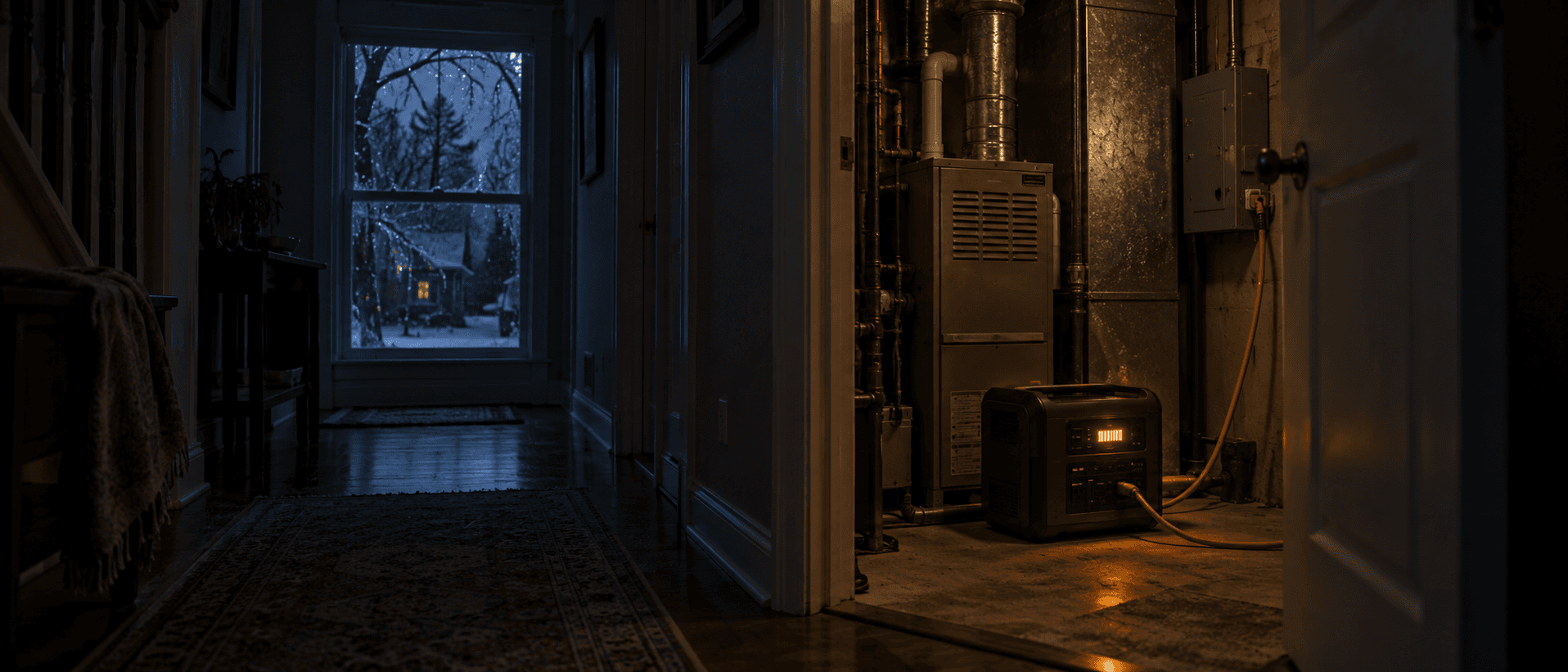
In February 2021, 246 Texans died in the winter storm, and close to two-thirds of those deaths were hypothermia. A gas furnace is no help in that situation. Without the few hundred watts it needs to light and move air, it sits cold even with gas at the meter. That small electrical load makes a power station sound like the obvious fix: a battery can't heat a house, but it can let the furnace do it.
It can. But the honest math says hours, not days. There's also a wiring quirk that stops many furnaces from lighting on battery power at all, and almost nobody mentions it until the furnace is clicking and failing at 2 a.m. This page covers both.
What a gas furnace actually draws
A gas furnace has four electrical parts, and they don't all run at once. Each time it starts, the inducer fan clears the flue (75W). Then the hot-surface igniter glows for about 37 seconds (400W). Then the gas lights and the control board proves the flame. Once the heat exchanger warms up, the blower starts pushing air through your ducts. Those first three figures come from Lawrence Berkeley National Laboratory's furnace model. The blower is the one that matters, at about 80% of the furnace's electricity, and it depends on which motor you have:
| Component | Older furnace (PSC blower) | Variable-speed (ECM blower) |
|---|---|---|
| Blower, heating speed | 490W | 284W |
| Inducer fan | 75W | 75W |
| Igniter (≈37 sec per start) | 400W | 400W |
| Controls, standby | 5W | 9W |
| Running total, burner on | ≈565W | ≈359W |
The blower figures are measured, not nameplate. Canada's National Research Council ran two identical test houses side by side and metered both blowers. They moved almost the same air, and the ECM did it on 58% of the power. If your furnace's manual or model sticker says "variable speed" or "ECM," you have the right-hand column. If you're not sure, assume the left. Sizing for the worse case is the whole point.
None of these loads is hard on an inverter. The igniter's 400W comes on before the blower starts, so the peak is well under 1,000W. Every station on this site has at least 1,500W continuous. Output isn't your constraint. Capacity is.
How many hours of heat a battery buys
A furnace doesn't run all hour. It cycles, and how much of each hour it runs depends on how cold it is outside. The DOE's furnace guideline gives a useful anchor: a house that needs 62,000 Btu/hr at its design low gets sized for an 80,000 Btu/hr furnace. At the coldest night your area is designed for, that furnace runs about 77% of each hour. On a milder outage night, call it half.
Add the blower and inducer at that share of the hour, standby the rest, and five igniter starts per hour (LBNL's model figure). That gives:
- Older PSC furnace: ~306Wh per hour at half-duty, ~457Wh per hour at design-low duty
- Variable-speed ECM furnace: ~205Wh per hour at half-duty, ~299Wh per hour at design-low duty
Against real usable capacity, after the 85% inverter haircut this site applies everywhere (the watt-hour calculator explains why):
| Unit (usable Wh) | Mild night (50% duty) | Design low (77% duty) |
|---|---|---|
| Jackery Explorer 1000 v2 (~910Wh) | 3.0h / 4.4h | 2.0h / 3.0h |
| Bluetti AC180 (~980Wh) | 3.2h / 4.8h | 2.1h / 3.3h |
| Anker SOLIX C2000 Gen 2 (~1,741Wh) | 5.7h / 8.5h | 3.8h / 5.8h |
| Bluetti Elite 200 v2 (~1,763Wh) | 5.8h / 8.6h | 3.9h / 5.9h |
| EcoFlow Delta Pro 3 (~3,482Wh) | 11.4h / 17.0h | 7.6h / 11.6h |
That table is the furnace running alone. In a real outage it shares the battery with the fridge, a CPAP, and the router, and the calculator is where you budget all of them together. The takeaway is plain: a 1kWh unit gets you one solid warm-up, not a night of heat. A 2kWh unit gets you through an evening. Only the 4kWh class gets close to keeping a furnace running overnight in real cold.
Why that's still a great trade
A few hours sounds disappointing until you compare it to the alternative people actually reach for: a plug-in space heater on the same battery. At 1,500W, a space heater turns every watt into 3.412 Btu/hr of heat, about 5,100 Btu/hr in total. A typical 80,000 Btu/hr furnace at a conservative 80% efficiency puts about 64,000 Btu/hr into the house on roughly 565W of electricity. Per watt-hour of battery, the furnace delivers about 33 times the heat, because the gas does the heating and the battery only runs the fans. A space heater would drain the same Elite 200 v2 in a little over an hour and warm one room. The furnace warms the whole house for most of an evening.
The grounding problem that keeps furnaces from lighting
This is the part the "just plug it in" advice skips. Your furnace proves it has a flame using flame rectification. The control board sends a tiny current, usually less than 10 microamps, through the flame itself, and if it sees that current come back, it keeps the gas valve open. That trick depends on a clean reference between neutral and ground. HVAC technicians check that the voltage between the two reads 0.0. At your house that bond is made in the main panel.
Most portable power stations don't bond neutral to ground. The neutral floats. Mike Sokol, who writes about RV electrical systems, notes that power stations from Jackery, Southwire and Bluetti are built this way. It's a sensible safety choice for a box you might plug a hair dryer into at a campsite. But when a furnace's control board sees a floating neutral, the typical symptom is a furnace that runs its inducer, glows the igniter, lights, fails to prove flame, and shuts the gas off.
How you connect the furnace decides whether you hit this:
Through a furnace transfer switch, you don't. A single-circuit furnace switch like Reliance's Easy/Tran keeps the furnace's neutral tied to your panel's neutral bar and only switches the hot wire between utility and battery. The panel's own neutral-ground bond does the job flame rectification needs, and the floating-neutral station is exactly the right kind of source to plug in. Reliance itself warns about the opposite case: a source that's also bonded puts neutral and ground in parallel. Never add a bonding plug to a transfer-switch setup.
Plugged straight into the station, you might. Some electricians fit a furnace with a cord and plug where local code allows. That puts the furnace on the station's floating neutral with no panel in between. That's the setup where furnaces refuse to light, and where the RV world's fix, a neutral-ground bonding plug in a spare outlet, comes in. If you go that route, let the electrician who wires the cord make the call, not a forum thread.
Never feed the furnace through a wall outlet
A male-to-male cord from a power station into a wall or dryer outlet energizes your house wiring and, unless the main breaker is off, the utility lines too. OSHA warns that connecting a generator to a building's wiring without a properly installed transfer switch can energize wiring for great distances, and that's how lineworkers restoring power get electrocuted. A furnace transfer switch's break-before-make relay exists to make that physically impossible. Reliance says to have a licensed electrician or heating contractor install its furnace-side models.
The Easy/Tran comes in two sizes, the TF151 (1,875W, 15A) and the TF201 (2,500W, 20A). Either clears a residential furnace's running load with lots of room, so match it to your furnace circuit's breaker, not to the furnace.
The safety upside nobody prices in
A battery burns nothing. It can sit in the utility closet right next to the furnace, on a short cord, with no exhaust. A gas generator can't. The CPSC says one portable generator produces as much carbon monoxide as hundreds of cars and must never run inside a home or garage. In the 2021 Texas storm, carbon monoxide caused 8% of the deaths. The furnace itself still burns gas and vents exhaust, so keep battery-backed CO alarms on every floor regardless. But the power source is no longer one of your hazards.
How to run it during an outage
- Warm the house, then stop. Run the furnace until the house is a few degrees above where you'd normally set it, then turn the thermostat down and let the house coast. Restart when it gets uncomfortable. You're spending battery in bursts instead of trickling it away keeping one setpoint.
- Shrink the house. Close doors and supply vents to rooms nobody's using, so the heat you paid battery for stays where people are.
- Keep the fridge on a schedule, not a dedicated circuit. If one battery runs both, alternate them. The CDC says a closed fridge keeps food safely cold for about 4 hours, so it can wait while the furnace runs. A cold house can't.
- Recharge whenever you can. Plug the station back into the wall the moment power returns. In a rolling-blackout event like ERCOT's, the gap between outages is your refill window. The Texas storm prep guide covers that pattern.
Which battery for furnace backup
If the furnace is the load that decides your purchase, 2kWh is the floor that makes sense. A 1kWh unit gives you a warm-up, and that's it. Among 2kWh units, the Anker SOLIX C2000 Gen 2 is the one we'd buy for this job. It's the cheapest 2kWh capacity we've reviewed, its 2,400W of continuous output is far more than a furnace needs, and it can add an expansion battery later. The Bluetti Elite 200 v2 runs a few minutes longer in the table above and was our pick at its September price of $849. At $1,199 it's $299 more than the Anker, so wait for a sale.
If you need the furnace to run through a real-cold night without rationing, the EcoFlow Delta Pro 3 is the only portable unit here with the capacity to do it. At that point, also read the whole-house battery backup guide before you spend $2,800. And if what you really want is days of heat, the honest answer is in our generator vs power station guide: a battery is a bridge, and a long freeze is where fuel wins.
For everything else in the house, the home backup rankings sort every unit here by the same capacity math this page uses.
What we'd buy for furnace backup
Capacity is the only spec that matters for a furnace, so these are sorted by how long they keep one running. Hours assume an older PSC furnace, the worse case, from a mild night down to your area's design low.
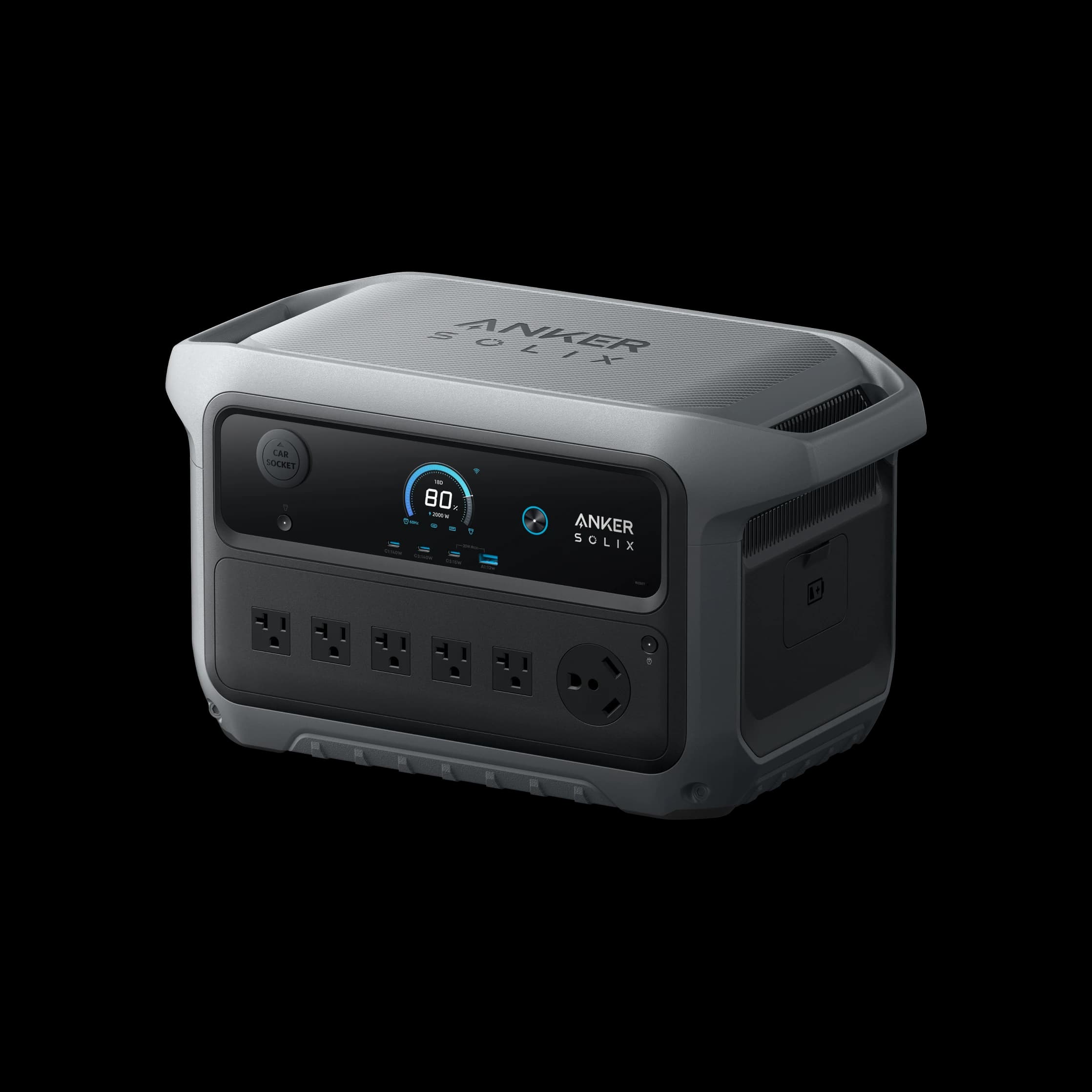
The cheapest 2kWh capacity we've reviewed, and for a furnace, watt-hours are runtime. It gets a PSC furnace through an evening of real cold, longer with a variable-speed blower. It's also the only 2kWh unit here that takes an expansion pack: a BP2000 Gen 2 doubles it to 4kWh, the same capacity as the Delta Pro 3 below.
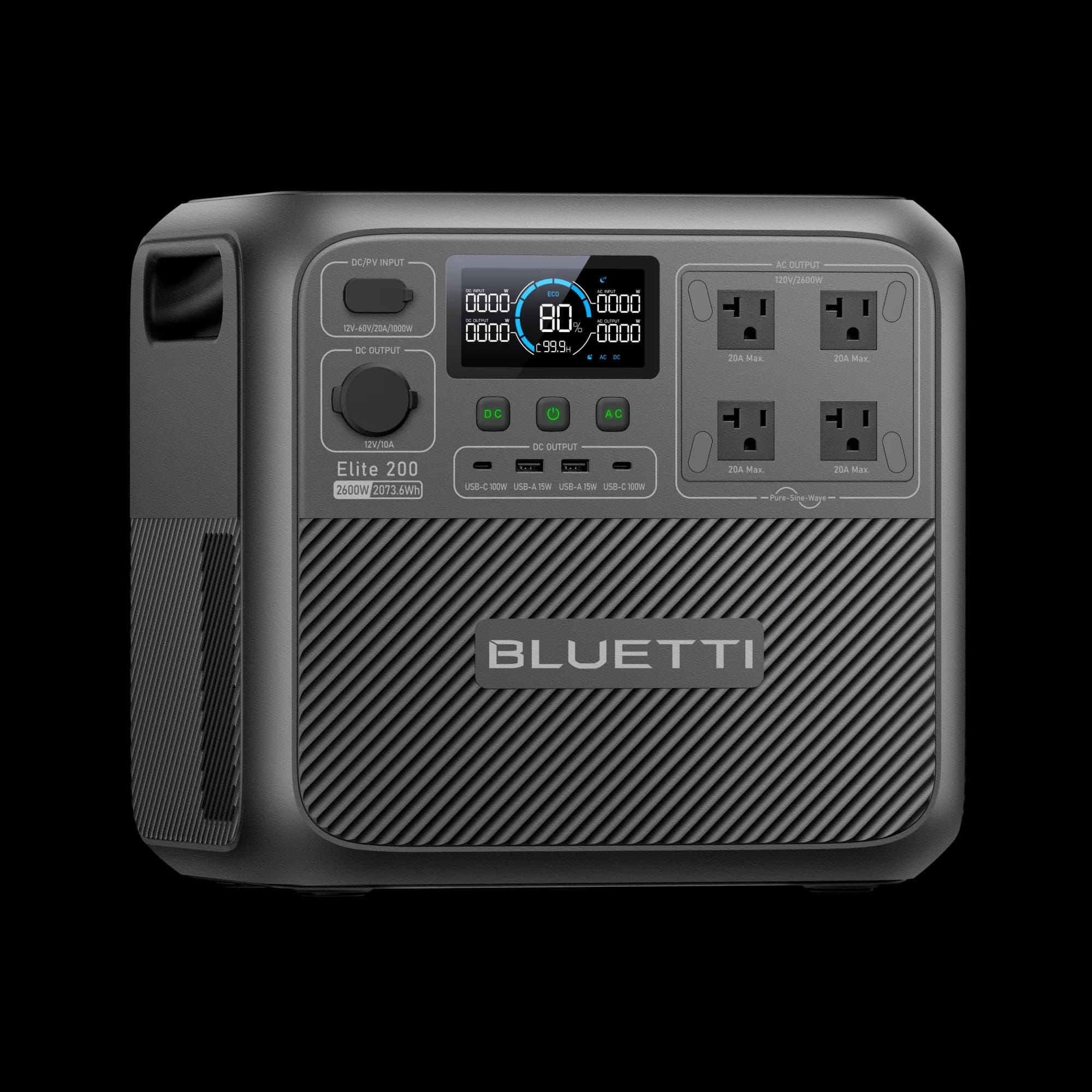
A few minutes more furnace runtime than the Anker and a longer-lived battery, but $1,199 at Bluetti is $299 more for it. Worth buying when a sale brings it near the Anker's price. It can't add an expansion battery, so only if 2kWh is where you'll stay.
Check price at BluettiCode AFF5% — 5% off home backup at BluettiAmazon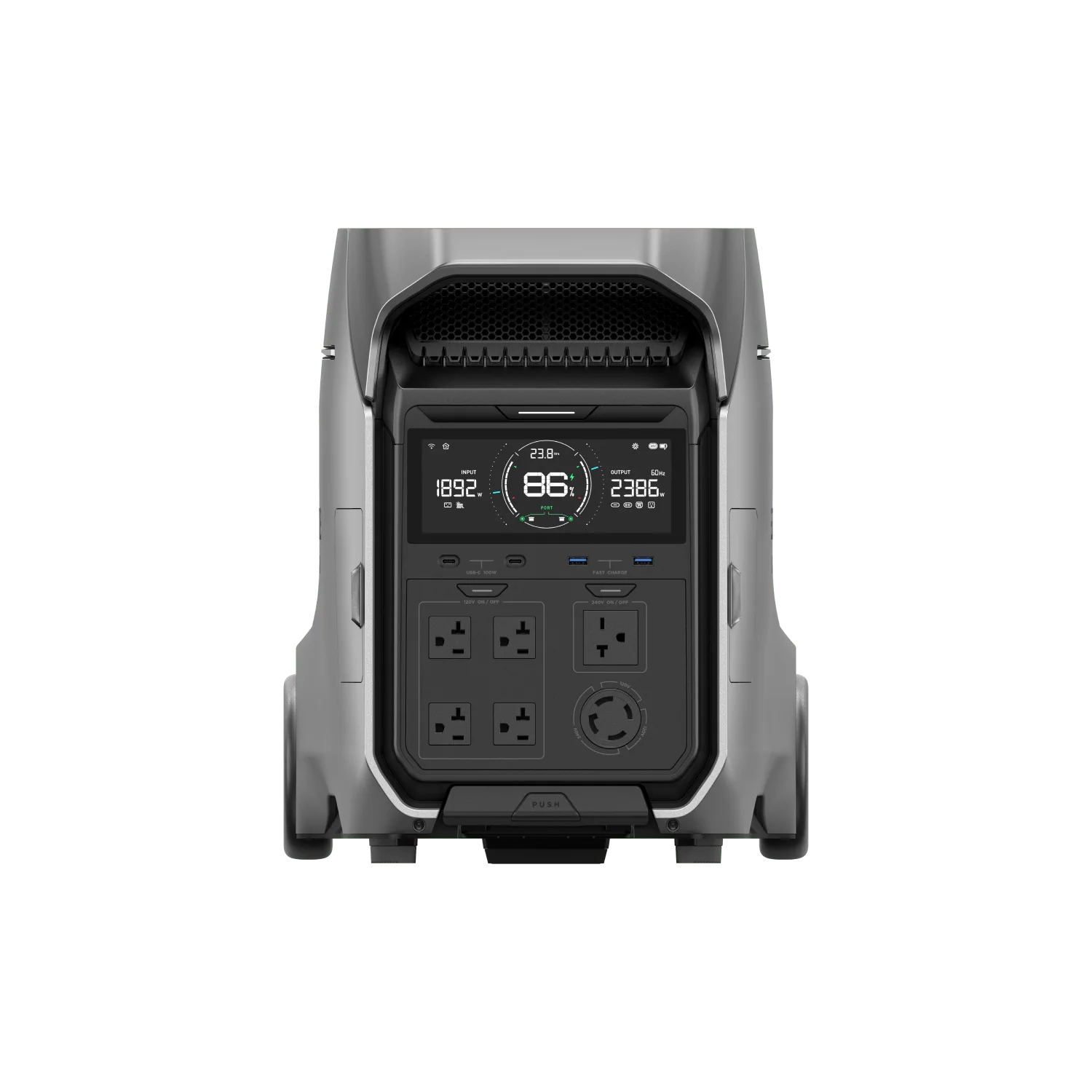
The only portable unit here that keeps a PSC furnace running most of a cold night without rationing. Its 240V output means the same battery can feed a multi-circuit transfer switch later.
Frequently asked
- Does a gas furnace work without electricity?
- No. The gas gives you the heat, but the furnace can't start or run without electricity. Its inducer fan has to clear the flue before it fires, an electric igniter lights the burner, the control board proves the flame, and the blower pushes the warm air through your ducts. Lawrence Berkeley National Laboratory's furnace model puts the igniter at 400W for about 37 seconds per start and the inducer at 75W. The blower is the big load: 490W for an older PSC motor in a Canadian field measurement, 284W for a variable-speed ECM motor.
- How long will a power station run a gas furnace?
- Hours, not days. An older furnace with a PSC blower uses about 306Wh per hour when it runs half of each hour, and about 457Wh per hour near your area's design low, where a typically oversized furnace runs about three-quarters of the time. That gives a 1kWh-class unit like the Jackery Explorer 1000 v2 about 2 to 3 hours of heat, a 2kWh unit like the Bluetti Elite 200 v2 about 4 to 6 hours, and the 4kWh EcoFlow Delta Pro 3 about 7.6 to 11 hours. Newer variable-speed furnaces stretch each figure by roughly half.
- Why won't my furnace light when it's plugged into a power station?
- Most likely the neutral isn't bonded to ground. A furnace proves its flame with a tiny current through the flame itself, called flame rectification. That only works when neutral and ground are tied together, which your main panel does. Most portable power stations leave the neutral floating, so a furnace plugged straight into one can light the igniter, fail to prove flame, and shut the gas off. A transfer switch that keeps the furnace on your house neutral fixes it, because the panel's own bond does the job.
- Is a power station safer than a gas generator for running a furnace?
- For carbon monoxide, yes. A battery burns nothing, so it can sit indoors next to the furnace. The CPSC says a single portable generator produces as much CO as hundreds of cars and must never run inside a home or garage. Carbon monoxide caused 8% of the deaths in Texas's February 2021 winter storm. Either way, the furnace itself still burns gas and vents exhaust, so keep battery-backed CO alarms working through any outage.
- Can I plug a power station into a wall outlet to power the furnace circuit?
- No. A male-to-male cord into a wall or dryer outlet backfeeds your house wiring, and potentially the utility lines, with nothing to stop it. OSHA warns that connecting a generator to a building's wiring without a properly installed transfer switch can energize wiring systems for great distances, which is how lineworkers restoring power get electrocuted. A furnace transfer switch exists precisely to make that impossible.
Sources
- 01checked 2026-09-30
LBNL furnace electricity model parameters: hot surface igniter 400 watts with 0.62 minutes on-time per cycle; inducer fan 75 watts; standby 5 watts (PSC blower option) or 9 watts (BPM/ECM option); 5 furnace cycles per hour; blower on-delay of 120 seconds per cycle; furnace blowers account for about 80% of total furnace electricity consumption
https://eta-publications.lbl.gov/sites/default/files/furnace_blower_electricity_national_and_regional_savings_potential_lbnl_417e.pdf - 02checked 2026-09-30
Canadian Centre for Housing Technology side-by-side houses (NRC, 2002): measured furnace blower power was 284W for the ECM and 490W for the PSC motor in heating speed, and 16.5W vs 350W in circulation speed, with near-identical heating airflow
https://nrc-publications.canada.ca/eng/view/accepted/?id=97997ac4-834d-44ff-a5ec-fd4a3f890d39 - 03checked 2026-09-30
DOE Building America measure guideline (Brand and Rose, 2012): uses 'the typical 80,000 Btu/hr furnace' as its reference unit, and gives the example of a house with a 62,000 Btu/hr calculated heating load at design conditions in Minneapolis being sized for 80,000 Btu/hr with a 1.3 multiplier
https://www1.eere.energy.gov/buildings/publications/pdfs/building_america/highefficiency_gas_furnaces.pdf - 04checked 2026-09-30
Flame rectification: the ignition control proves flame by passing current, usually less than 10 microamps, through the flame; reversed polarity means no flame sense, and technicians should confirm 0.0 VAC between neutral and ground
https://www.achrnews.com/articles/98085-troubleshooting-a-flame-rectification-system - 05checked 2026-09-30
Mike Sokol (RV Electricity, January 2023): solar generators from Jackery, Southwire and Bluetti are built with a floating neutral-ground arrangement, and a neutral-ground bonding plug in a spare outlet is the workaround for equipment that requires a bond
https://rvelectricity.substack.com/p/solar-generator-n-g-bonding - 06checked 2026-09-30
Reliance Controls: connecting a bonded-neutral generator through a transfer switch that does not switch the neutral places the neutral and ground wires in parallel, because they are bonded at both the service entrance and the generator; this is 'objectionable current' under NEC 250.6
https://reliancecontrols.com/blogs/bonded-neutral-vs-floating-neutral-what-you-need-to-know-1 - 07checked 2026-09-30
Reliance Controls Easy/Tran TF151/TF201 furnace transfer switch: UL 1008 listed single-circuit switch; 1,875 maximum watts (TF151, 15A) or 2,500 (TF201, 20A); the white wire connects to both the neutral to the furnace and the neutral from the panel; should be connected by a licensed electrician or heating contractor; break-before-make action prevents feeding generator power to the utility
https://assets.usesi.com/product-media/installation-instructions/USESI_93120_installation_instructions.pdf - 08checked 2026-09-30
OSHA: never attach a generator directly to a structure's electrical system unless a qualified electrician has installed it with a transfer switch; attaching one without a properly installed transfer switch can energize wiring systems for great distances
https://www.osha.gov/sites/default/files/publications/OSHA3286.pdf - 09checked 2026-09-30
CPSC: never use portable generators indoors or in garages, basements, or sheds; one generator produces as much CO as hundreds of cars
https://www.cpsc.gov/Safety-Education/Safety-Guides/Carbon-Monoxide-Home/Generators-and-Engine-Driven-Tools - 10checked 2026-09-30
Texas DSHS final count of the February 2021 winter storm: 246 deaths, close to two-thirds from hypothermia and 8% from carbon monoxide poisoning
https://www.click2houston.com/news/texas/2022/01/02/texas-puts-final-estimate-of-winter-storm-death-toll-at-246/ - 11checked 2026-09-18
Jackery Explorer 1000 v2: 1,070Wh LiFePO4, 1,500W continuous output with 3,000W surge
https://www.jackery.com/products/jackery-explorer-1000-v2 - 12checked 2026-09-18
Bluetti AC180: 1,152Wh, 1,800W continuous AC output
https://www.bluettipower.com/products/ac180 - 13checked 2026-09-18
Anker SOLIX C2000 Gen 2: 2,048Wh LFP, 2,400W continuous AC with 4,000W peak, expandable to 4kWh with a BP2000 Gen 2 pack
https://www.ankersolix.com/products/c2000-gen2 - 14checked 2026-10-07
Bluetti Elite 200 v2: US$1,199.00 on Bluetti's store, up from $849 on 2026-09-18; 2,073.6Wh LiFePO4, 2,600W continuous AC output, no expansion battery support
https://www.bluettipower.com/products/bluetti-elite-200-v2-portable-power-station - 15checked 2026-10-07
Anker SOLIX C2000 Gen 2: $849.99 on Anker's store on 2026-10-07 during a dated sale, $899.99 on 2026-09-18; 2,048Wh LFP, 2,400W continuous AC with 4,000W peak, expandable to 4kWh with a BP2000 Gen 2 pack
https://www.ankersolix.com/products/c2000-gen2 - 16checked 2026-07-31
CDC: a closed refrigerator keeps food safely cold for about 4 hours during a power outage
https://www.cdc.gov/food-safety/foods/keep-food-safe-after-emergency.html - 17checked 2026-09-30
EcoFlow Delta Pro 3: base 4,096Wh unit, $2,799 regular price on Amazon, in stock as of 2026-09-30
https://www.amazon.com/dp/B0D14FMFZD - 18checked 2026-08-24
EcoFlow Delta Pro 3: 4,096Wh LFP battery, 4,000W continuous AC output at 120V/240V, expandable to 12kWh
https://us.ecoflow.com/products/delta-pro-3-portable-power-station