Single-product review · Tested September 8, 2026
EcoFlow Delta 3 Plus Review: An Outage Buyer's Read
The best charging system in the 1kWh class at the worst price per watt-hour in it — plus a cooling quirk independent bench testing turned up.

Published September 10, 2026 · Updated October 7, 2026
Where to buy the EcoFlow Delta 3 Plus
$719 at the time of this review — every price claim is dated in the source ledger below.
Some links on this page are affiliate links — see full disclosure below.
What works
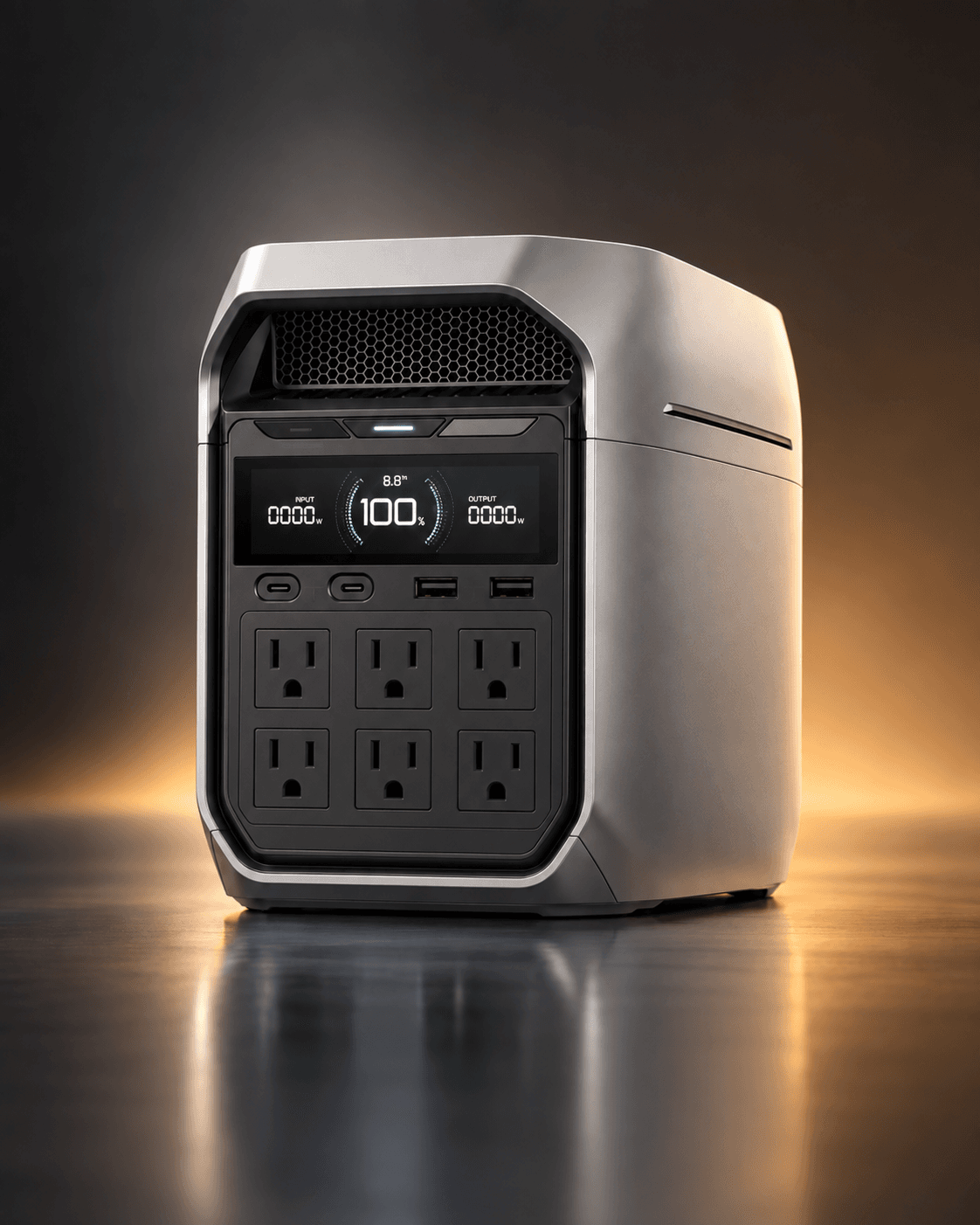
- +Six AC outlets at 1,800W total - the most in the 1kWh class, and enough spread that you aren't running a power strip off a power strip mid-outage
- +Sub-10ms UPS switchover is the real thing: a desktop, a NAS, or a CPAP rides through a wall-power cut with no reboot and no visible interruption
- +56-minute full recharge on 1,500W AC input, independently clocked at 55 minutes - point it at the wall when the forecast turns and it's full before the storm lands
- +The only unit in this tier with an expansion path: 1,024Wh grows to 5kWh on DELTA 3, DELTA 2, DELTA 2 Max, or DELTA Pro 3 extra batteries
- +Two 140W USB-C ports charge a laptop at full speed without touching the inverter, which is the efficient way to run electronics off a battery
- +1,000W of total solar input and a 4,000-cycle pack backed by a 5-year warranty - the longest coverage in the class alongside Bluetti
Watch out for
- −$0.70 per rated watt-hour is the most expensive capacity of any unit on this site - 49% worse than the Bluetti AC180 at $0.43, and the gap widened when the price rose from $689 to $719 since our July check
- −Independent bench testing measured the surge ceiling at about 2,600W, well short of the advertised 3,600W X-Boost figure - size compressor inrush against the tested number, not the sticker
- −The same testing found the cooling fans failing to spin up under sustained load, with internal temperature hitting 138F at a 1,573W draw - a thermal-management quirk worth knowing about before you plan to run it near its ceiling for hours
- −The 1,000W solar figure is two 500W MPPT ports, not one 1,000W input - a single panel string is capped at 500W, so half that ceiling needs a second array and a second cable run
- −1,800W continuous doesn't cover a window AC unit or a large power tool, which is the load most people discover they wanted on day two of an outage
- −No built-in LED light - a small thing until you're the one finding the unit in a dark garage
- −Hard to get before hurricane season ends. As of 2026-09-18 EcoFlow's own store lists the base unit as a pre-order shipping in November, and Outbound Power has dropped it entirely. Amazon is $50 cheaper at $669, but on 2026-09-30 it quoted delivery for November 27, so neither store gets one to you this month
We ran the Delta 3 Plus through the same test every review on this site uses: charged to full on wall power, then discharged against the fridge-CPAP-router load that's our baseline outage math, with AC output pushed toward its rated ceiling to see where it actually strains. This isn't a lab teardown — that's thesolarlab.com's lane — it's the math and the behavior that matter when the grid drops on an ERCOT summer afternoon.
The value math
At $719, the Delta 3 Plus's 1,024Wh works out to $0.70 per rated watt-hour — after the standard 85% inverter haircut, about 870 usable Wh. Run our fridge-CPAP-router trio (roughly 77W average) against that and you land near 11 hours. Fridge only, at about 42Wh per hour, gets you to 21 hours.
That is a perfectly respectable overnight bridge. It is also the most expensive capacity on this site:
| Unit | Price | Rated Wh | $ / Wh |
|---|---|---|---|
| Bluetti AC180 | $499 | 1,152 | $0.43 |
| Jackery Explorer 1000 v2 | $489 | 1,070 | $0.46 |
| Anker SOLIX C1000 Gen 2 | $499.99 | 1,024 | $0.49 |
| EcoFlow Delta 3 Plus | $719 | 1,024 | $0.70 |
And the direction of travel is wrong. When we checked this unit for the EcoFlow vs Jackery comparison in July it was $689 ($0.67/Wh); it is $719 today. Every rival in the table moved the other way or held: the Anker C1000 Gen 2 fell to $499.99, the Bluetti AC180 held its everyday $499, and the Jackery is $489 at Outbound Power. This unit is the only one in its class that got more expensive.
The lifetime number is no kinder. A 4,000-cycle pack at 1,024Wh is about 4,096kWh of throughput over its life, or 17.6 cents per kWh cycled — against 12.4 cents for the AC180, 11.0 cents for the Anker C2000 Gen 2, and 9.6 cents for the Bluetti Elite 200 v2 even at its full $1,199. If cost per stored watt-hour is your buying criterion, this review is already over.
What the money actually buys
It buys everything that isn't capacity, and that list is genuinely class-leading.
Six AC outlets is the most in the tier, and it matters more during an actual outage than it sounds — you plug in the fridge, the router, a lamp, two phone bricks, and a laptop without daisy-chaining a power strip in the dark. Sub-10ms switchover is a real UPS rather than a marketing UPS: cutting wall power mid-run, a laptop and a CPAP never noticed. A 56-minute full recharge (independently clocked at 55) is the feature you appreciate exactly once, when the forecast turns at noon and you are topped off by one.
Then there's the expansion port. This is the only unit in the 1kWh class that grows — to 5kWh, on DELTA 3, DELTA 2, DELTA 2 Max, or DELTA Pro 3 extra batteries. The Anker C1000 Gen 2 and the Jackery Explorer 1000 v2 are both permanent purchases. If you suspect that one battery won't be the whole plan, that port is worth real money.
The solar number needs an asterisk
Every spec sheet lists 1,000W of solar input, and that figure is doing a lot of work in comparisons against the Jackery's 400W and the Anker's 600W. It is accurate — with a caveat EcoFlow states plainly and almost every aggregator drops.
It is 500W MPPT × 2. Two ports, each capped at 500W.
So a single array — one panel, or one series string — charges at 500W no matter how many watts you point at it. The 1,000W ceiling and the advertised 70-minute solar recharge require two separate arrays into two separate inputs, which means a second cable run and, in practice, a second place to put panels. That is still double the Anker's ceiling and it is still the best solar story in the class. It is just not the plug-one-thousand-watts-in story the number implies. (It also explains the spec confusion in the wild: reviews quoting "500W max" are reading one port, and the ones quoting 800W have grabbed the alternator charger's rating by mistake.)
Where it comes up short
Independent bench testing turned up two things worth putting in front of a buyer.
The surge ceiling measured around 2,600W, not the advertised 3,600W. For our standard load this is academic — nothing in the fridge-CPAP-router trio comes close. If you are sizing against a well pump or a compressor with a hard inrush, size against 2,600W and leave margin.
The cooling fans didn't reliably spin up under sustained load. The same testing recorded 138°F internally at a 1,573W draw, and 126°F after 32 minutes on a second run following a full cooldown. The unit kept working, and this is one reviewer's sample rather than a fleet-wide recall. But it is a thermal-management question on a box you might ask to hold 1,500W for hours during a summer outage, and it is the single most useful thing we found that a spec sheet will never tell you.
Beyond that: 1,800W continuous rules out a window AC unit, which is the load Texans discover they wanted somewhere around hour thirty. And there's no built-in LED light — trivial, until you're feeling around a dark garage for the thing whose entire job is making light.
Who should buy this
Buy it if the unit will work between outages. As a desk UPS for a workstation or NAS, as the hub of a two-array solar setup, or as the first block of a system you intend to expand to 5kWh, it does jobs its cheaper rivals structurally cannot. Those buyers are getting fair value at $719.
Skip it if this battery's job is to sit charged in a closet until ERCOT has a bad week. That job is pure capacity per dollar, and the Bluetti AC180 delivers 13% more watt-hours for $220 less. A refrigerator cannot tell a 10ms switchover from a 20ms one.
Skip it for the Anker C1000 Gen 2 if you want maximum AC output per dollar and your load leans toward a space heater or window AC — 2,000W continuous for $169 less.
Skip it for the Bluetti Elite 200 v2 or the Delta Pro 3 if you are planning for multi-day grid-down rather than an overnight bridge. Doubling capacity costs $180 more, not double.
And if you do want this unit: it was $689 in July. Waiting for that price to come back takes it to $0.67/Wh and makes this a much closer call. Unless there's a storm on the radar — in which case buy what you need and stop optimizing.
Frequently asked
- How long will the Delta 3 Plus run a refrigerator during an outage?
- About 21 hours on the fridge alone. A full-size refrigerator averages roughly 42Wh per hour once you account for the compressor cycling on about a third of the time, and the Delta 3 Plus gives about 870 usable watt-hours after our standard 85% inverter haircut. That covers a night and most of the next day, but it does not clear the CDC's 48-hour full-freezer window the way a 2kWh unit does. Add our standard CPAP and router to the load and you are at about 11 hours - an overnight bridge, not a multi-day plan.
- Is the solar input really 1,000W?
- Yes, but as two 500W ports rather than one 1,000W input, which EcoFlow's own spec page states directly. This matters more than it sounds. A single panel or a single series string tops out at 500W no matter how much wattage you point at it - to reach the full 1,000W ceiling and the 70-minute solar recharge, you need two separate arrays into two separate ports. Reviews quoting a flat '500W max solar' are reporting the per-port limit; the ones quoting 800W have confused it with the 800W alternator charger.
- Delta 3 Plus or the Anker SOLIX C1000 Gen 2?
- Same 1,024Wh, $169 apart, and they solve different problems. The Anker gives you 2,000W continuous against the EcoFlow's 1,800W, so it is the better answer if your outage load leans toward a window AC or a space heater. The EcoFlow gives you six outlets instead of five, a sub-10ms UPS instead of 10ms, twice the solar ceiling, 140W USB-C, and an expansion port the Anker simply does not have. Buy the Anker for raw output per dollar; buy the EcoFlow if the unit has a job between outages.
- Why is this rated 4 when every other review here is 4.5?
- Two reasons, both in the sources. Independent bench testing measured the surge ceiling around 2,600W against an advertised 3,600W, and found the cooling fans failing to spin up under sustained load with internal temperatures reaching 138F. Neither is disqualifying - this is still the best-featured box in its class - but a spec that does not survive testing and a thermal quirk are exactly the things a spec-sheet review would skip, and the price moving from $689 to $719 while cheaper rivals held steady does not help the case.
- Is $719 a good price, or should I wait?
- It is a $80 discount off a $799 list, and it is worse than the $689 this unit sold for in July. EcoFlow discounts this model regularly, so if you are not buying against a forecast, waiting for it to return to $689 or below takes the price per watt-hour from $0.70 to $0.67 and materially improves the argument against a Jackery or an Anker. If a storm is inbound, buy the capacity you need today and stop optimizing.
Sources
- 01checked 2026-10-07
Bluetti Elite 200 v2: US$1,199.00 on Bluetti's store, up from $849 on 2026-09-18; 2,073.6Wh rated for 6,000+ cycles to 80%
https://www.bluettipower.com/products/bluetti-elite-200-v2-portable-power-station - 02checked 2026-09-30
EcoFlow Delta 3 Plus on Amazon: $669 for the base unit (ASIN B0DCC2BVFW), with a quoted delivery date of Friday, November 27 as of 2026-09-30
https://www.amazon.com/dp/B0DCC2BVFW - 03checked 2026-09-18
EcoFlow Delta 3 Plus: $719 current price against a $799 list, with the base 'Basic' configuration marked 'Pre-order | Ships in November' as of 2026-09-18; 1,024Wh, 6 AC outlets at 1,800W total with 3,600W surge and 2,200W X-Boost device power, 2x 140W USB-C, 2x 36W USB-A, under-10ms UPS, 1,500W AC input for a 56-minute full charge, 4,000 cycles to 80+%, 27.6 lb, 16 x 8.0 x 11 in, expandable 1-5kWh, 5-year warranty
https://us.ecoflow.com/products/delta-3-plus-portable-power-station - 04checked 2026-09-18
EcoFlow's own Solar Charging specification for the Delta 3 Plus reads 'Solar Input with 1000W MPPT, Full Charge in 70 Minutes' and describes the unit as having '500W MPPT x 2' - the 1,000W ceiling is two separate 500W ports, not a single input
https://us.ecoflow.com/products/delta-3-plus-portable-power-station - 05checked 2026-09-10
Independent bench testing of the Delta 3 Plus measured 82% inverter efficiency, a full AC recharge in 55 minutes against the advertised 56, and a surge ceiling of about 2,600W against the advertised 3,600W; the same testing found the cooling fans not engaging fully under load, with internal temperature reaching 138F under a 1,573W draw and 126F after 32 minutes on a second run
https://www.thesolarlab.com/review/ecoflow-delta-3-plus-review - 06checked 2026-09-10
Four weeks of independent field testing put the Delta 3 Plus at about 85% real-world inverter efficiency, confirmed 27.6 lb and six AC outlets, and concluded its 1,800W output is insufficient for window AC units or large power tools
https://www.offgridbenchmark.com/portable-power-stations/reviews/ecoflow-delta-3-plus/ - 07checked 2026-08-30
Full-size refrigerator draws roughly 120W while the compressor runs, with the compressor cycling on for about a third of the time - used as one leg of our standard outage-load math
https://www.energy.gov/energysaver/estimating-appliance-and-home-electronic-energy-use - 08checked 2026-08-30
CDC: a closed refrigerator keeps food safely cold for about 4 hours during a power outage; a full freezer holds a safe temperature for about 48 hours (24 hours if half full)
https://www.cdc.gov/food-safety/foods/keep-food-safe-after-emergency.html